Managing Canine DM Muscle Atrophy: Massage & PROM
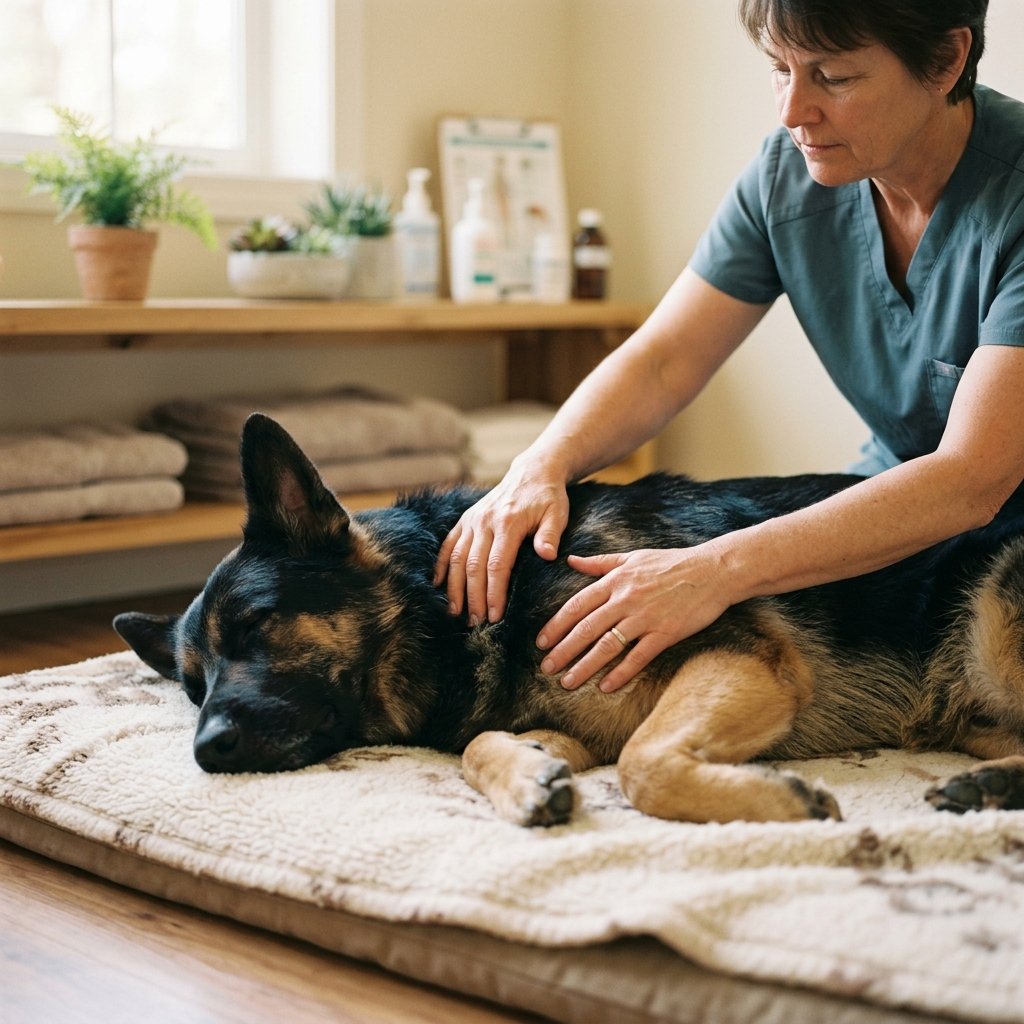
As Degenerative Myelopathy interrupts the motor pathways along the spinal cord, your German Shepherd's rear muscles will stop receiving electrical contraction signals. This leads to **disuse muscle atrophy**, where the muscles in the thighs, gluteals, and lower limbs rapidly shrink. While you cannot cure the neuropathy, you can delay muscle wasting and prevent stiff joint contractures using systematic massage and stretching.
1. Passive Range of Motion (PROM) Exercises
PROM exercises involve manually moving your dog's legs through their natural range of motion. This lubricates the joints with synovial fluid, maintains flexibility, and helps the brain remember leg motion patterns.
- How to Perform PROM: Lay your GSD comfortably on their side on a padded orthopedic bed. Start with the top leg. Hold the paw in one hand and support the knee joint with the other. Gently flex the hip, knee, and ankle up toward the body, then slowly extend the leg backward.
- Protocol: Perform 10–15 bicycle-like repetitions per leg, twice a day. Never force a joint if you feel resistance or if your dog reacts with discomfort.
2. Circulation Massage Techniques
Because paralyzed legs do not move, blood and lymphatic circulation slows down, which can lead to cold extremities and swelling. Massage stimulates vascular flow, delivering fresh oxygen and nutrients to the atrophy-weakened muscles.
- Effleurage (Gliding Strokes): Using flat hands, apply light-to-medium pressure starting at the toes and gliding upward toward the hip and spine. This stroke pushes fluid back toward the heart. Perform this for 2–3 minutes per leg before stretching.
- Petrissage (Kneading): Gently grasp the thigh muscle block between your fingers and thumb, kneading it in a soft, circular motion. This releases muscle tension and improves tissue elasticity.
Physiotherapy Research Note
Millis, D. L., & Levine, D. (2014). Canine rehabilitation and physical therapy. Elsevier Health Sciences, 18(2), 291-297. Manual therapy combined with daily PROM is clinically shown to delay joint ankylosis and preserve sarcomere length in denervated muscle fibers.
3. Preventing Muscle Contractures
When a muscle stays shortened and unused for a long time, it can undergo **contracture**—where the muscle fibers turn into stiff, non-elastic scar tissue. If this happens, your GSD's legs will become permanently locked in a bent position, making it impossible to fit them comfortably into a rear wheelchair harness.
Daily stretching, warm compresses prior to massage, and keeping your GSD in a standing position (using a chest-and-belly support harness) for a few minutes daily are key to preventing contractures.